Skip to content

Safari jacket and military shirt: from uniforms to civilian style
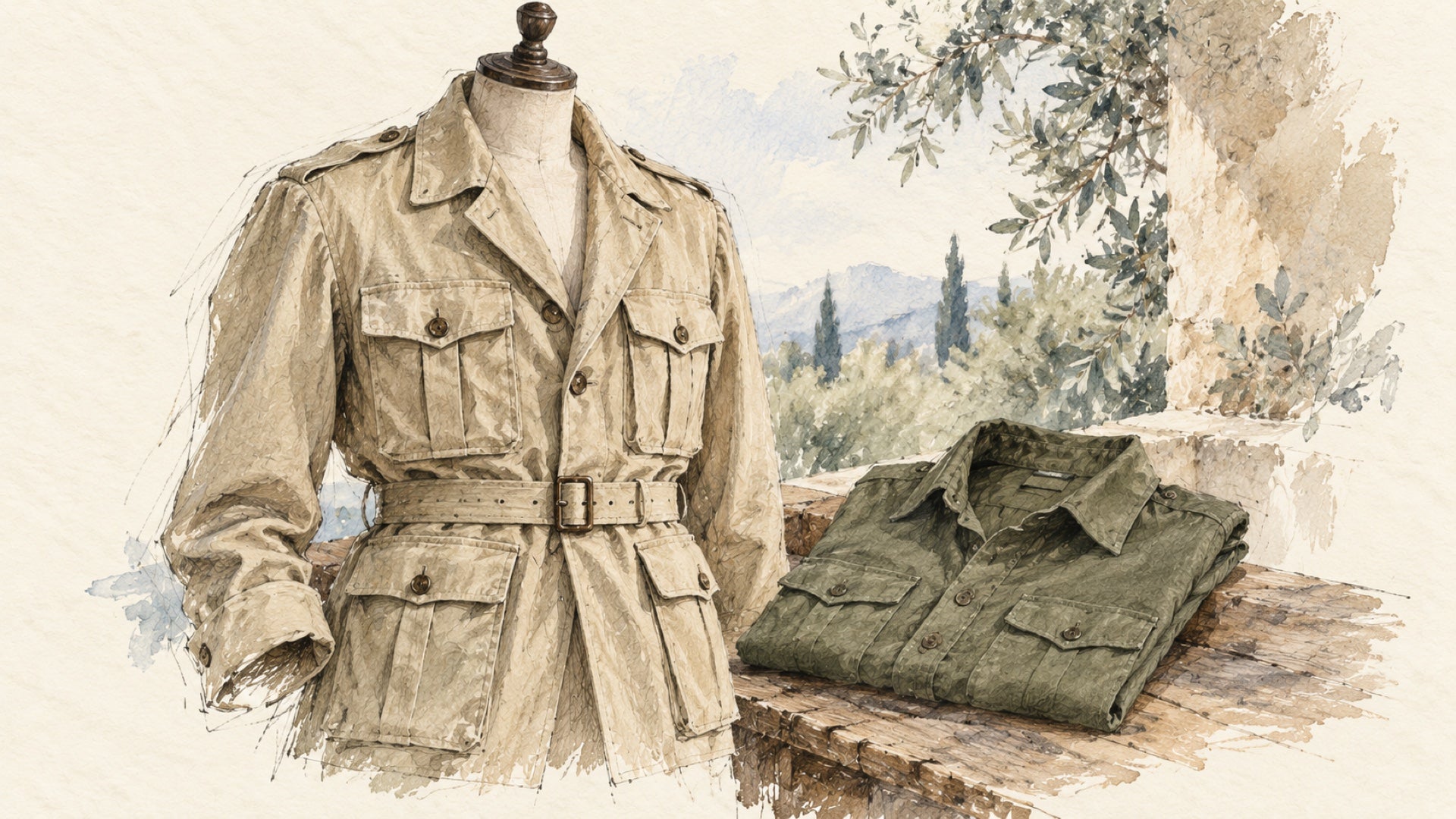
Many of the garments we wear every day have a military past: the trench coat, the chinos, the bomber jacket. Among these, the safari jacket and the military shirt hold a special place. Born to be functional in difficult climates and extreme conditions, they became symbols throughout the twentieth century of adventure, effortless elegance, and even designer fashion. We tell you how a garment designed for soldiers and explorers entered civilian wardrobes.
It all starts with a color: khaki
Even before the style, there is the color. For much of the nineteenth century, many European armies wore bright colors: the red of the British jackets is the most famous example. In battle, however, those colors made the soldiers very easy targets.
The turning point comes in British India. Around 1846, the Corps of Guides, a unit formed on the northwestern frontier under the command of Harry Lumsden, with his second-in-command William Hodson, adopted uniforms in a dusty color that blended into the landscape. Sources tell different versions of how that dye was obtained: some speak of white fabric dyed with mud or plant extracts, others of fabrics brought from England. The name, however, is certain: khaki derives from a Persian and Urdu word meaning "dust".
Within a few decades, khaki spread among the British troops serving in warm climates, and at the beginning of the twentieth century, along with greens and grays, it replaced bright colors almost everywhere. The military shirt, since then, has the colors of the earth.
Then, every army found its own shade. In Italy, at the beginning of the twentieth century, the Royal Army adopted olive-drab, a color designed to blend into the alpine and rocky landscapes where it was feared they might have to fight. In the United States, olive drab became established, the dull olive green that during World War II became the color of millions of uniforms and countless field shirts. It is precisely these tones—khaki, sand, olive-drab, and olive green—that we still instinctively associate with a "military" shirt, even when we see it in a city shop window.
From hunting in India to the "safari jacket"
Along with the color, a style is also born. In colonial India, officers and hunters wore a lightweight cotton jacket called a shikar jacket, from the Hindi and Urdu word meaning hunting. It was a practical garment: dusty-colored fabric, a not-too-long cut, and above all, many spacious pockets to carry a knife, ammunition, binoculars, and everything else needed, without the need for belts and leather bags.
At the beginning of the twentieth century, this jacket accompanied explorers and hunters in Africa, and the Swahili word safari, meaning "journey", entered English usage thanks in part to the famous hunting trips of figures such as Theodore Roosevelt. In the 1930s, it is said that Ernest Hemingway designed a "bush jacket" for an American equipment supplier, and soon the style appeared in the catalogs of major stores for explorers.
In Italy, this garment took on a name all its own: safari jacket, from the Sahara Desert. The term spread during the years of the colonial campaigns in Africa, when lightweight canvas jackets and shirts with pockets and belts became part of the uniforms for warm climates. Safari jackets are therefore halfway between a shirt and a jacket: they are often worn over bare skin or a T-shirt, but they have the structure and pockets of a lightweight outerwear garment.
The details that come from uniforms
If you look closely at a safari jacket or a military-inspired shirt, you will find a series of details that all have a precise function:
- Pleated pockets: they have a fold that allows them to expand when full, to hold maps, ammunition, or notebooks.
- Buttoned flaps: they close the pockets to prevent losing anything during movement.
- Epaulettes: they were used to attach rank insignia and to hold the straps of bags and rifles on the shoulders.
- Waist belt: in the classic safari jacket, it cinches the garment and makes it fit the body more closely.
- Durable fabrics: cotton canvas, drill, and twill, chosen to withstand wear and the sun.
- Sleeve roll tabs: a small strip with a button that keeps the sleeves rolled above the elbow, very common in field shirts.
Each of these elements has survived even when its original function has disappeared. Today, no one hangs a rifle from an epaulette, but that detail continues to give the garment character.
The desert, war, and cinema
World War II made the military shirt a global image. In the campaigns in North Africa, soldiers from various armies wore lightweight shirts and jackets in sand-colored fabrics, often with the sleeves rolled up. The photographs and newsreels of the time fixed that image in the collective imagination.
After the war, many military garments ended up in surplus stores, sold at low prices to students, artists, and workers. This is how field shirts and safari jackets entered civilian life, first as practical and affordable clothing, then as a style choice. Cinema did the rest: adventure films set in Africa and the desert transformed the safari jacket into the uniform of the fascinating traveler, part explorer and part gentleman.
The navy also made its contribution. The so-called CPO shirt, from the acronym for the United States Navy petty officers, was a heavy blue wool shirt with two flap pockets, worn as an outer layer. Since the war, it has become a classic of casual wear, especially in checkered versions.
From the trenches to the runway
In the 1960s, the safari jacket makes its most surprising leap: it enters haute couture. In 1968, Yves Saint Laurent presents his safari jacket, a women's safari jacket fastened with laces, which becomes one of the iconic images of his work. Other designers, in the same years, propose refined men's versions in linen, cotton, and even silk.
In the 1970s, the safari jacket becomes almost a uniform for the elegant man on vacation or traveling, and in Italy, during that decade, it can be seen worn by journalists, actors, and entrepreneurs. Its charm lies precisely in its ambiguity: it is a garment with military roots, but worn effortlessly, it communicates freedom, travel, and an informal elegance.
Why uniforms are still popular
There is a reason why military clothing continues to influence menswear: it is designed to work. Every pocket, every reinforced seam, every fabric choice serves a concrete need. When these garments enter civilian life, they bring with them an impression of solidity and substance that few other styles manage to convey.
At the same time, the military-inspired shirt lends itself to endless reinterpretations: softer, shorter, more tailored, in colors other than khaki and olive green. It is one of the rare cases where a garment born to standardize ends up expressing personality.
And it is curious to think that the color of the dust from a frontier region, chosen so as not to be seen, has become one of the most beloved and recognizable colors in the men's wardrobe. From sand to olive green, the tones born to camouflage are now chosen precisely to be noticed discreetly.
Stories sewn into pockets
The next time you see a shirt with pleated pockets and epaulettes, you will know that behind it are the Indian frontier, the African deserts, and the runways of Paris. In our blog you will find other stories like this. And if you like an elegance that speaks of travel, you can discover Affinito shirts and garments online or in our stores.
Affinito Camiceria stores
You can try on the shirts, request custom tailoring, and see the embroidery in person at all our points of sale:
- Afragola (NA): Via Alcide De Gasperi, 38
- Afragola (NA): Le Porte di Napoli Shopping Center, Via Santa Maria la Nova, 1
- Casalnuovo di Napoli (NA): Via Lagno, 7
- Frattamaggiore (NA): Piazza Riscatto, 28
- Nola (NA): Corso Tommaso Vitale, 112
- Nola (NA): Via San Felice, 65
- Quarto (NA): Via Masullo, 76
- Empoli (FI): Centro*Empoli, Via Raffaello Sanzio
- Bologna: Centronova Shopping Center
- Mondovì (CN): Mondovicino Shopping Center & Retail Park
- Posted in:
- Curiosità