Skip to content

The shirt pocket: when it was born and why formal shirts don't have one

Have you ever wondered why some shirts have a chest pocket and others don't? The shirt pocket seems like an obvious, almost natural detail, yet in the long history of this garment spanning several centuries, it is a rather recent addition. To understand where it comes from, and why more formal shirts continue to omit it, we need to take a step back and remember that for much of its life, the shirt was not meant to be seen.
When the shirt was underwear
Until the 19th century, and for much of the early 20th century, the men's shirt was considered an undergarment. It was worn against the skin, protected outer garments (which were more expensive and harder to wash) from sweat, and was changed and washed with a frequency that no jacket would have endured. Over it went the waistcoat, the jacket, and sometimes the overcoat: only the collar, cuffs, and the shirtfront of the shirt were visible.
In this context, a pocket would have made no sense. Who would put something in a hidden pocket beneath two layers of wool, unreachable without unbuttoning half their clothes? Personal items, from watches to handkerchiefs, found their place in the pockets of the waistcoat and jacket, which were designed specifically to be accessible. Besides, taking off one's jacket in public was considered impolite in many situations, so the shirt effectively remained a functional undergarment.
The pocket comes from work, not from the drawing room
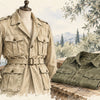
The first shirts with clearly visible pockets emerged in the world of work and the military. Workers, farmers, ranchers, and soldiers often worked with their sleeves rolled up, especially in hot weather, and needed to keep small items close at hand: a pencil, a notebook, tobacco, matches. Work shirts made from sturdy fabrics such as denim, chambray, and heavy twill thus began to feature one or two patch pockets, often closed with a buttoned flap to prevent losing anything during movement.
The same happened with uniforms: military shirts from the first half of the 20th century almost always had two chest pockets with flaps, a style we still find today in safari-style or "utility" shirts. American western shirts, with their shaped flap pockets, also belong to this family: garments designed for those who spend the day outdoors and have no jacket in which to keep their things.
Why on the left
The single pocket is almost always located on the left side of the chest. The most reasonable explanation is practical: most people are right-handed, and the right hand can more easily reach a pocket placed on the left. It is the same logic that governs the jacket pocket, the one intended for a pocket square. However, there is no written rule that has fixed its position: it is a custom that has become established through use.
From the work shirt to the office shirt
During the 20th century, things changed. Heating in offices, lighter clothing, and greater informality in workplaces meant that more and more men spent the day without a jacket. The shirt finally became a garment to be shown, and with this change in role came the question: where do I put my pen, my glasses, my pack of cigarettes?
Especially in the United States, starting in the middle of the century, the pocket spread to office shirts as well. It was during those years that an accessory that has become almost caricatural appeared: the plastic pen holder to be slipped into the shirt pocket to prevent the fabric from being stained with ink, the ultimate symbol of the office worker and the engineer. Over time, the shirt with a pocket became the standard in much of industrial production, to the point that for many people a shirt without a pocket seems almost incomplete.
Some also tell curious stories related to objects kept in the pockets of shirts and jackets, such as the folded speech that in 1912 cushioned the bullet aimed at Theodore Roosevelt (though it was in his jacket pocket). Anecdotes aside, the pocket became the modern man's most convenient "drawer" in those years.
Why formal shirts do not have a pocket
And here we come to the point. If the pocket is so convenient, why are more elegant shirts almost always without one? The reasons are varied and intertwine with one another.
- Historical legacy. The formal shirt descends directly from that undergarment shirt worn beneath the jacket. If the garment is designed to be worn with a suit, the pockets already exist: those of the jacket. The pocket on the shirt becomes superfluous.
- Clean lines. A patch pocket interrupts the front of the shirt, adding thickness and an extra seam. Under a jacket it can create a small bulge, especially if there is something inside. Without a pocket, the chest remains smooth and the tie hangs more neatly.
- The language of style. In the tradition of men's clothing, the pocket is associated with work and practicality. On a formal shirt, or a tuxedo shirt, it would sound like a discordant note, a bit like a tool belt on a dark suit.
- The sartorial school. Many artisanal shirtmakers, and the Neapolitan school in particular, consider the shirt without a pocket to be the purest version of the garment. A pocket can be added upon request, but it is not part of the "classic" model.
A detail that tells of use
In this sense, the pocket is a small clue: it tells you what kind of life a shirt was designed for. An Oxford shirt with an applied pocket speaks of leisure, university, weekends. A white poplin shirt without a pocket speaks of a jacket, a tie, important occasions. It is not a rigid rule, but a language that has formed over time, and which many shirtmakers still respect today.
The many forms of the pocket
Even when it is present, the pocket is not always the same. Over time, different variants have emerged, each with its own history.
- Round-bottom patch pocket: the most widespread, soft and discreet.
- Pointed pocket, with an arrow-shaped bottom: bolder, more common in casual shirts.
- Pocket with flap: a direct descendant of military and work shirts, designed to retain the contents.
- Double pocket: typical of safari, western, or workwear shirts.
- Pocket with central pleat: increases capacity and is another nod to utilitarian clothing.
One detail that enthusiasts notice immediately is the alignment of the pattern. On striped or checked shirts, a well-made pocket is cut so that the pattern continues uninterrupted from the front to the pocket, almost making it invisible. It is a job that requires more fabric and more time, and it is one of those signs of care that distinguish a well-made shirt.
The pocket today: a choice, not a requirement
Today, the presence or absence of the pocket is above all a matter of taste and context. Casual shirts and those made from sturdier fabrics often adopt it, while formal shirts and more classic ones tend to do without. In custom shirtmaking, it is the customer who decides, and it is not uncommon for those who wear a shirt without a jacket every day to choose to add one for convenience.
What is worth remembering is that behind such a small detail lies a piece of social history: the shirt's transition from a hidden garment to the protagonist of men's clothing. Every time you slip a pen into a shirt pocket, you are using an invention born in the fields, workshops, and barracks, which later moved into the offices. And every time you choose a formal shirt without a pocket, you are respecting, perhaps without knowing it, the legacy of when the shirt was worn under the jacket and no one really saw it.
If you like these stories, you can find other insights on our blog about the details that make a shirt unique.
Discover Affinito shirts
With or without a pocket, every shirt has a distinct character. In the Affinito collections you will find classic models with a clean front and more informal shirts designed for leisure time, with that attention to detail that comes from the tradition of Neapolitan shirtmaking. If you want to get an idea, you can browse all our shirts or stop by one of our stores.
Affinito Shirt Stores
You can try on the shirts, request custom tailoring, and see the embroidery in person at all our retail locations:
- Afragola (NA): Via Alcide De Gasperi, 66
- Afragola (NA): Le Porte di Napoli Shopping Center, Via Santa Maria la Nova, 1
- Casalnuovo di Napoli (NA): Via Lagno, 7
- Frattamaggiore (NA): Piazza Riscatto, 28
- Nola (NA): Corso Tommaso Vitale, 113
- Nola (NA): Via San Felice, 62
- Quarto (NA): Via Masullo, 76
- Empoli (FI): Via Raffaello Sanzio, 199
- Bologna: Centronova Shopping Center
- Mondovì (CN): Mondovicino Shopping Center & Retail Park
- Posted in:
- Curiosità