Skip to content

Anatomy of a shirt: how many pieces and seams are needed
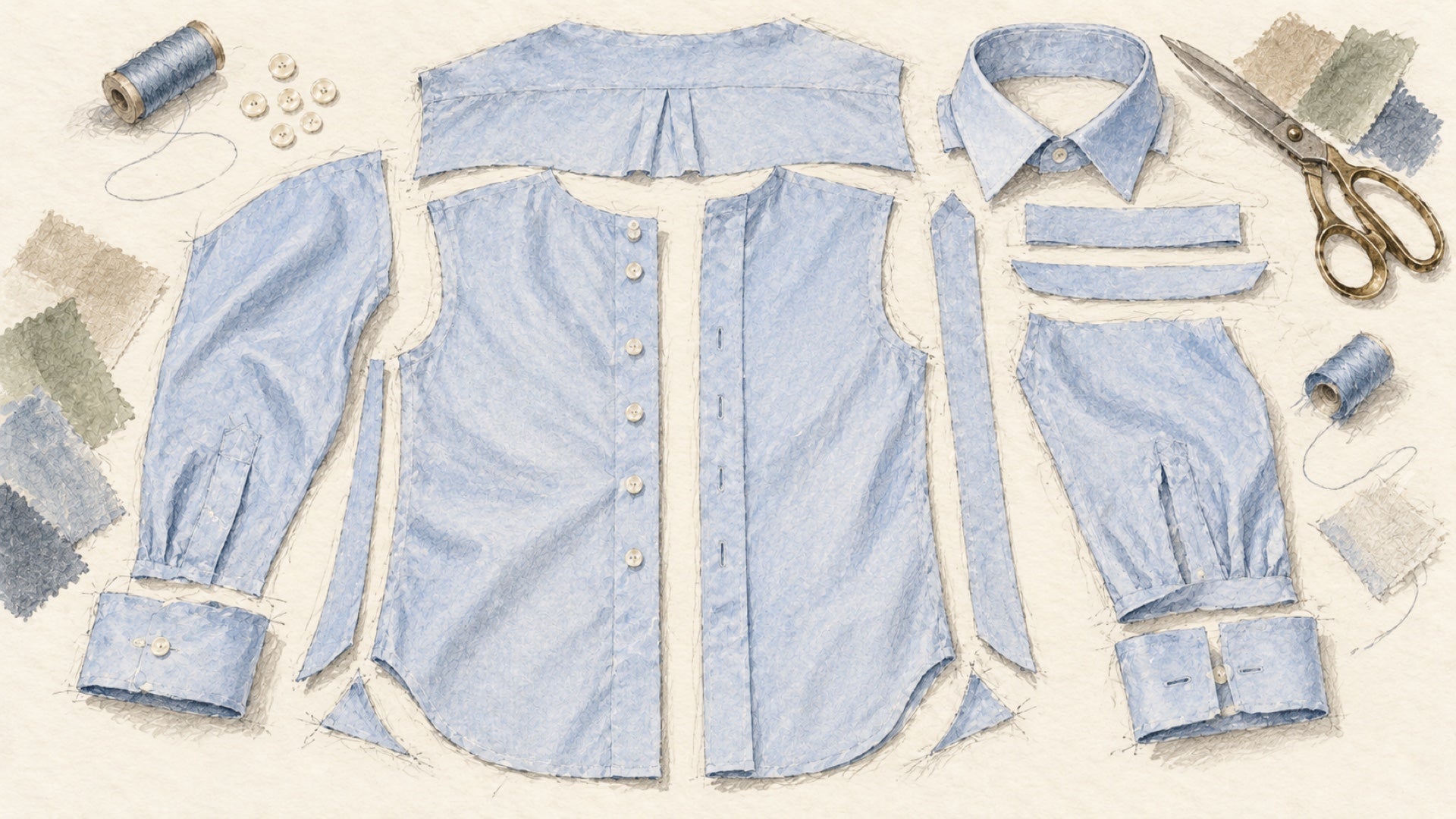
If you were asked how many pieces make up a shirt, what would you say? Five, six? The front, the back, the sleeves, the collar. In reality, the anatomy of a shirt is much more complex than it seems: between visible parts, inner layers, and small reinforcements, it easily comes to about twenty pieces of fabric, to which are added interfacings, buttons, and dozens of meters of thread. Mentally taking it apart, piece by piece, is the best way to understand how much work is hidden behind a garment we wear almost every day.
The body: front, back, and yoke
Let's start with the largest parts, those that form the "body" of the shirt.
- Two front panels, right and left. One of the two has the buttonholes, the other the buttons. The edge where the shirt closes can be constructed in different ways: with an applied placket, a slightly protruding strip of fabric, or folded inside, for a cleaner front.
- One back panel, usually in a single piece, on which any pleats or darts are located.
- The yoke, the band that joins the shoulders. It is almost always double, with an outer and an inner layer, so already here the pieces become two. If the yoke is divided in the center, the pieces rise to four.
So, the body alone accounts for four to six pieces of fabric. And that's just the beginning.
The collar: the most complex part
The collar is considered the heart of a shirt, and for good reason. It is the most visible part, the one that frames the face, and it is also the most complex to construct. It is made up of two distinct elements:
- The collar leaf, that is, the part that folds and has the points. It is composed of two layers of fabric, top and bottom, with an interfacing in the middle that gives it body.
- The collar band (or collar stand), the band that goes around the neck and on which the first button is located. This too is made up of two layers of fabric and an interfacing.
That makes four pieces of fabric and at least two of interfacing, plus any pocket for the collar stays. The way the collar leaf is joined to the collar band, and the collar band to the shirt, determines how the collar will sit on the neck and how it will fall under the jacket. In handmade shirts, the attachment of the collar is one of the most delicate operations and the one on which the shirtmaker pays the most attention.
Sleeves, cuffs, and plackets
The sleeves seem simple: two tubes of fabric. In reality, each sleeve brings with it a small collection of components.
- Two sleeves, each cut as a single piece.
- Four pieces for the cuffs: each cuff has an outer and an inner side, plus the interfacing. In double cuffs, those for cufflinks, the fabric is longer because it folds over itself.
- The sleeve openings, also called plackets or slits, which allow you to put your hand in. They are often made of two strips of fabric, one wider and one narrower, for each sleeve: another four pieces.
In some shirts, the sleeves are gathered or pleated where they attach to the cuffs, to give a little more room at the wrist. Then, in the Neapolitan tradition, it is common to have gathering even at the point where the sleeve attaches to the shoulder: a detail that makes the shirt more comfortable in movement and has become almost a distinctive feature.
The pieces you don't see
In addition to the main parts, a well-made shirt contains some minor elements, often invisible, which however play an important role.
- The fly, or triangular reinforcement: a small piece of fabric sewn at the base of the sides, where the side seams end and the slit opens. It serves to prevent the fabric from tearing at that point subjected to tension. In the past it was very common, today it is found mainly in shirts of more refined workmanship.
- The pocket, when present.
- The interfacings of the collar, collar band, and cuffs, and often also that of the center placket.
- The labels, with brand, composition, and washing instructions.
Adding it all up, a classic shirt easily comes to eighteen to twenty-five pieces of fabric, depending on the model, without considering interfacings and small accessories.
The seams: the thread that holds everything together
If there are many pieces, there are even more seams. Each piece must be joined to the others, finished on the edges, topstitched where needed. The main seams of a shirt are:
- the side seams, which join the front and back along the sides;
- the underarm seams, often made in continuity with the side seams;
- the sleeve head, that is, the attachment of the sleeve to the body;
- the attachment of the yoke to the front and back;
- the seams of the collar, collar band, and cuffs, with their topstitching;
- the bottom hem;
- the buttonholes and the button attachment.
Bound or English
Not all seams are equal. In shirts, two types of seams are mainly used, designed not to leave frayed edges inside. The bound seam folds the fabric edges into each other and fixes them with a double topstitch, very robust: it is the typical one for work shirts and jeans, but it is also used in classic shirtmaking. The English seam encloses the edges in a small fabric tunnel, with a single topstitch visible on the outside, for a cleaner and lighter appearance.
The stitch density
A detail that enthusiasts observe carefully is the number of stitches per centimeter. In quality shirts, the topstitching is very dense, even seven or eight stitches per centimeter, and almost invisible. Denser stitches mean more resistant and flatter seams, which do not pucker the fabric. However, they require more time and precisely adjusted machines, and that is why they are a sign of care.
Buttons and buttonholes: the numbers of details
Even the buttons tell a lot. A classic shirt usually has seven or eight on the front, including the one on the collar band, one or two for each cuff, and one for each sleeve opening. Button-down collars add two on the points, plus one on the back in some vintage versions. Not infrequently, you will also find a spare button sewn on the bottom or the label. In total, it easily comes to twelve, fifteen buttons.
Each button has its buttonhole, and the buttonholes are one of the points where you notice the difference between industrial and artisanal workmanship. Handmade buttonholes, still a pride of Neapolitan shirtmaking today, require minutes of work each: the fabric is cut and then finished stitch by stitch with a strong thread. Even the buttons can be attached by hand, often with a small "stem" of thread that raises them from the fabric and makes them easier to button.
A puzzle that becomes a garment
At the end of this journey, the shirt appears for what it really is: a small puzzle in which dozens of elements must fit together perfectly. Just one millimeter too much in the cut of the yoke, a poorly pulled seam on the sleeve head, a crookedly attached collar, and the result changes. This is also why shirtmaking is considered a trade in itself, distinct from the tailoring of jackets: it has its techniques, its secrets, its language.
The next time you button a shirt, try to count the pieces you can recognize. You will discover a garment much richer than you thought. On our blog you will find other curiosities dedicated to the individual details of the shirt.
Discover Affinito shirts
Behind every shirt is a job made of pieces, seams, and small gestures. In the Affinito collections you will find shirts made with attention to detail, from the collar to the cuffs, in the sign of the Neapolitan tradition. You can discover all the shirts online or observe them up close in our stores.
Affinito Shirtmaking Stores
You can try the shirts, request custom-made, and see the embroideries in person in all our points of sale:
- Afragola (NA): Via Alcide De Gasperi, 66
- Afragola (NA): Le Porte di Napoli Shopping Center, Via Santa Maria la Nova, 1
- Casalnuovo di Napoli (NA): Via Lagno, 7
- Frattamaggiore (NA): Piazza Riscatto, 28
- Nola (NA): Corso Tommaso Vitale, 113
- Nola (NA): Via San Felice, 62
- Quarto (NA): Via Masullo, 76
- Empoli (FI): Via Raffaello Sanzio, 199
- Bologna: Centronova Shopping Center
- Mondovì (CN): Mondovicino Shopping Center & Retail Park
- Posted in:
- Curiosità