Skip to content

The detachable collar: when shirts had interchangeable collars

Today we take for granted that the collar is part of the shirt, sewn on once and for all. Yet for about a century, that was not the case. The detachable collar was a separate item that was bought, washed, and changed separately, attached to the shirt with small metal buttons. It is a story that speaks of cleanliness, domestic economy, industry, and even advertising, and that has left traces in the language we still use today.
An idea born in the kitchen
The most widely told story, the one that the American city of Troy, in the state of New York, considers part of its identity, dates back to 1827. A woman named Hannah Lord Montague, tired of having to wash her husband's entire shirts just because the collar got dirty, had a simple idea: cut off the collar, wash it separately, and reattach it to the shirt with laces. The shirt could thus be worn longer, while the collar, the most visible part and the one most prone to getting dirty, was kept always clean.
As often happens with stories of inventions, it is difficult to say whether Hannah Montague was truly the first to think of it. It is likely that similar solutions already existed in different forms. What is documented is that in Troy the idea became an industry: a local merchant, Reverend Ebenezer Brown, began producing and selling separate collars, and within a few decades the city became the main center of collar production in the United States, so much so that it earned the nickname "Collar City", the city of collars.
How it worked
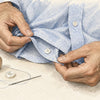
The system was ingenious in its simplicity. The shirt had only a stand-up collar, a low band around the neck, with two small holes: one in the front and one in the back. The collar, in turn, had corresponding holes. What joined the two parts were the collar buttons, small mushroom-shaped metal pins, often made of bone, metal, or mother-of-pearl.
- The collar was first attached to the back, with the back button.
- The shirt was put on.
- The front was closed by inserting the front button into the holes of the collar and the stand-up collar.
- Finally, the tie was knotted.
Often the cuffs were also detachable, following the same logic: they were the parts that wore out and got dirty the most, and replacing them cost much less than changing the entire shirt.
Linen, starch, and celluloid
Detachable collars were almost always white, even when the shirt was colored, and were starched until they became very stiff, with a cardboard-like consistency. Pure white was a sign of cleanliness and respectability: a pristine collar said that the person wearing it could afford to change it often.
During the 19th century, alternative materials were also experimented with. There were paper collars, cheap and disposable, and above all celluloid collars, one of the first plastics. Celluloid had a huge advantage: it was enough to wipe it with a damp cloth to clean it, without the need to wash and starch. However, it also had a significant drawback: it was highly flammable. It is no surprise that cloth collars continued to be preferred by those who could afford them.
An industry that employed thousands of people
Behind these small objects was a huge production. In Troy and other centers, thousands of people worked, mostly women, among cutters, seamstresses, pressers, and starching workers. The production of collars was also the setting for some of the first female labor union struggles in the United States, a little-known chapter of labor history linked precisely to this accessory.
Among these workers was Kate Mullany, a young collar laundry worker who in 1864 founded an all-female union in Troy, the Collar Laundry Union, considered one of the first women's unions in the United States. The laundry workers worked among steam, boiling water, bleaching chemicals, and red-hot irons, for very low wages. Their strike achieved significant raises, and Kate Mullany's house is recognized today as a historic site. It is curious to think that an object symbolizing bourgeois decorum, the starched white collar, is also linked to an important page in the history of workers' rights.
The collar man: when an accessory became an advertising icon
At the beginning of the 20th century, the Cluett, Peabody & Co. company, one of the major manufacturers in Troy, launched Arrow collars with an advertising campaign destined to make history. Illustrator Joseph Christian Leyendecker created the "Arrow Collar Man" for the brand, an elegant young man, with a perfect profile and a confident gaze. That imaginary character became one of the first great symbols of modern advertising: it is said that he received letters from admirers, as if he were a real person.
Leyendecker's illustrations accompanied the brand for about a quarter of a century, appearing in the most-read magazines of the time. The character was so famous that he was quoted in songs and shows, and his style, with the square jaw and impeccable hair, influenced the image of the elegant man in American advertising for years.
The Arrow Collar Man embodied an ideal of a modern, well-groomed, and respectable man, and helped make the collar much more than a simple accessory: a sign of style and social belonging.
White collars and blue collars
It is precisely from this world that an expression we still use today is born. "White collars" are office workers, those who work in an office, in contrast to "blue collars", the workers. The image comes directly from the starched and pristine collar of those who did desk work, contrasted with the colored and sturdy work shirts of those who worked in a factory or outdoors. The expression spread in the English language in the first decades of the 20th century and from there also reached Italian.
The decline
Starting from the 1910s and 1920s, the detachable collar begins to lose ground. The reasons are varied:
- the spread of domestic washing machines and laundry services makes it easier to wash the entire shirt;
- the need for comfort, accentuated by a more dynamic life and sports, makes soft and sewn-on collars preferable;
- World War I accustomed many men to more practical shirts;
- men's fashion gradually became more relaxed, and the stiff collar appeared increasingly outdated.
In the 1930s, the sewn-on collar is now the norm. The detachable collar does not disappear completely, but retreats to a few very specific contexts: the tuxedo and the most formal ceremonial suit, with the stiff wing collar, some uniforms, the clerical robe of many religious figures, and vintage clothing enthusiasts.
What remains of the detachable collar
Even though we rarely see it today, the detachable collar has left several legacies. The most obvious is the habit of considering the collar the most important part of the shirt, the one that is looked at first and on which the shirtmaker's work is focused. Then there is the white collar on a colored shirt, a combination that was born precisely from interchangeable collars and that has survived as a style choice. And there is the idea, still very much felt today, that a well-made and well-maintained collar says a lot about the person who wears it.
If you are curious about the stories of collars, on our blog you will find other articles dedicated to their evolution.
Discover Affinito shirts
Today the collar is sewn to the shirt, but it remains its most important detail. In the Affinito collections you will find collars of different shapes, carefully crafted to frame the face and maintain their shape. You can discover all the shirts online or come and visit us in our stores.
Affinito Shirt Stores
You can try on the shirts, request custom-made shirts, and see the embroidery in person at all our stores:
- Afragola (NA): Via Alcide De Gasperi, 38
- Afragola (NA): Le Porte di Napoli Shopping Center, Via Santa Maria la Nova, 1
- Casalnuovo di Napoli (NA): Via Lagno, 7
- Frattamaggiore (NA): Piazza Riscatto, 28
- Nola (NA): Corso Tommaso Vitale, 112
- Nola (NA): Via San Felice, 65
- Quarto (NA): Via Masullo, 76
- Empoli (FI): Centro*Empoli, Via Raffaello Sanzio
- Bologna: Centronova Shopping Center
- Mondovì (CN): Mondovicino Shopping Center & Retail Park
- Posted in:
- Curiosità