Skip to content

The small cannon and button on the sleeve: what are they for
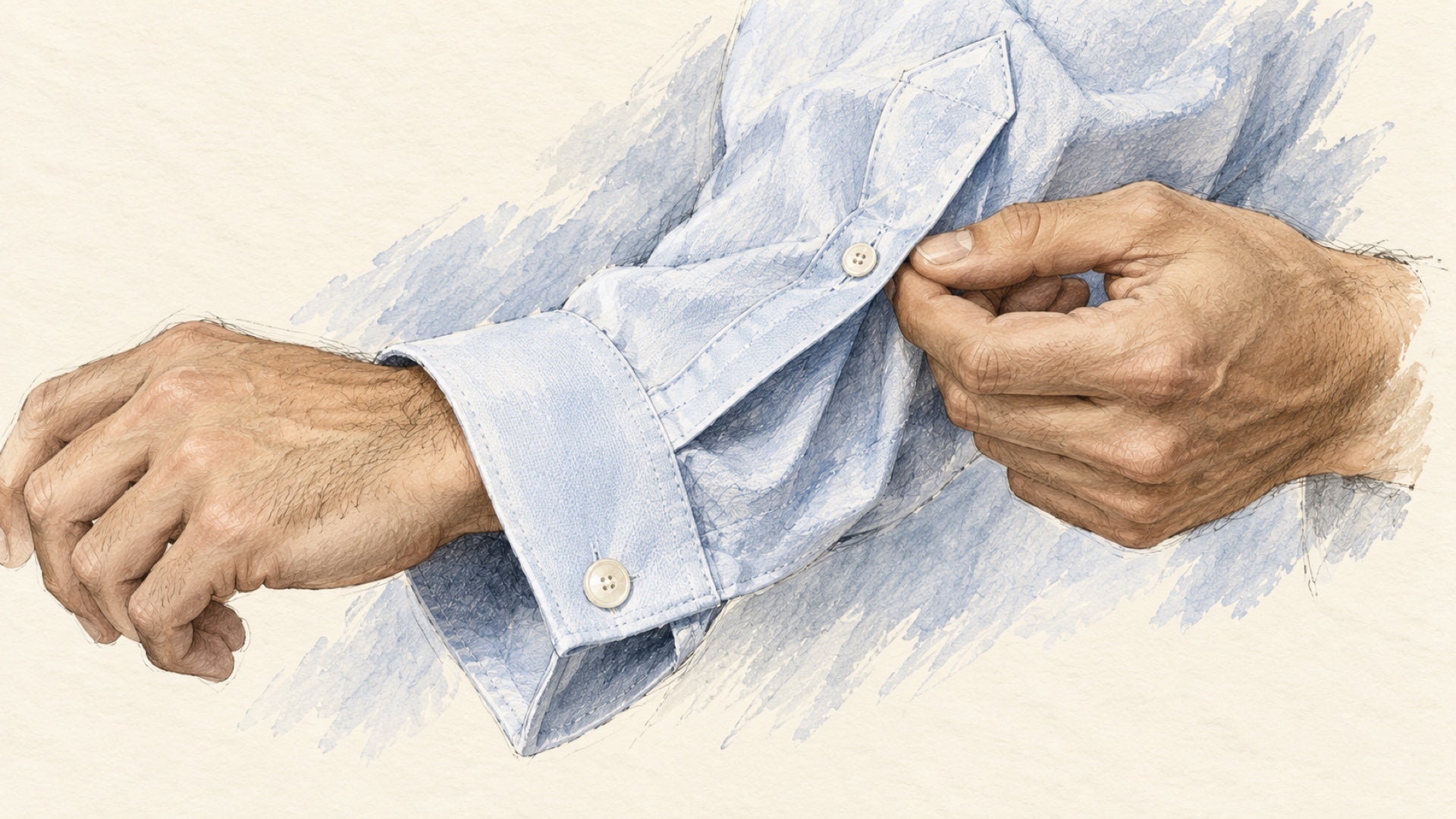
Take your shirt and look at the sleeve, just above the cuff. There is a small vertical opening, finished with a strip of fabric, and often in the middle of this opening there is a tiny button, smaller than all the others. These are two details that most people use without even noticing, and yet they have a precise name and a well-thought-out function. They are called the sleeve placket and sleeve button, and in shirtmaking they are considered one of the small tests of a shirt's construction. I will tell you what they are, why they exist and what curiosities are hidden behind these few centimeters of fabric.
What is the sleeve placket
To be able to put your hand into a sleeve that ends with a tight cuff, an opening is needed. Without it, the cuff would have to be as wide as the hand at its widest point, and it would look misshapen and saggy on the wrist. The solution is a vertical cut on the end of the sleeve, which allows the cuff to open completely when you unbutton the wrist button.
However, a cut in the fabric must be finished, otherwise it will fray and tear. The placket is precisely the strip of fabric that finishes this opening: two edges, one below and one above, with the upper one wider, which overlaps and covers the cut. In the most classic version, the upper flap ends at the top with a small point, which resembles the roof of a little house or the tip of an arrow, and is held by stitches that often form a small cross or rectangle pattern.
Why is it called that
In the language of Italian shirtmaking, the word "placket" is used to indicate a folded and sewn strip of fabric that finishes an opening. Not by chance, the same term also indicates the buttoning band on the front of many shirts, where the buttonholes are located. The name recalls the idea of a small tube, a "pipe" of double and supported fabric. There is no documented certainty about the precise origin of the term, but it is a word that has been part of the lexicon of Italian shirtmakers for generations, and depending on the area, it coexists with other expressions such as "sleeve slit" or "listino".
What is the sleeve button for
And here we are at the smallest protagonist. The sleeve button, which in English is called the gauntlet button, is located in the middle of the placket and serves to close the opening at its central point. Without it, when you move your arm, gesture, or reach out to grab something, the placket tends to open, revealing the wrist or forearm. The button holds the two flaps together and keeps the sleeve composed.
Its functions, in summary, are three:
- Aesthetics. It keeps the line of the sleeve clean and continuous, without unwanted openings, especially under the jacket.
- Practicality. When you want to roll up your sleeves, unbuttoning both the cuff and the button, the placket opens completely and the sleeve can go higher and more neatly.
- Structural. By blocking the two flaps, it distributes the tensions on the opening better and helps the placket not to deform over time.
Precisely because it is designed to stay hidden and work silently, the button is usually smaller than the front buttons. On many shirts, the buttonhole is vertical, parallel to the placket, but there are shirtmakers who prefer a horizontal buttonhole, a choice that follows the same logic as the buttons on the front: a buttonhole oriented in a certain way holds the button better when the tension comes from a precise direction.
A detail that tells the quality of construction
Not all shirts have a real placket. In simpler productions, the opening on the sleeve is often finished with a thin folded strip of fabric, a solution that is faster to sew, which works but does not have the same structure or the same aesthetic finish, and almost never includes the button. A real placket, with the pointed upper flap and the holding stitches, requires more fabric, more time, and more precision.
For this reason, many enthusiasts, when they look at a shirt for the first time, check exactly there: the regularity of the stitches, the symmetry of the point, the alignment with the cuff, the presence of the button. It is one of those points where the shirtmaker's care, or lack thereof, is immediately visible. In the Neapolitan shirtmaking tradition, moreover, the wrist area is often enriched by small pleats where the sleeve attaches to the cuff, which give softness and movement: another example of how a few centimeters can contain a lot of craftsmanship.
A little history: from tied sleeves to modern cuffs
For centuries, shirt sleeves ended with tight bands, laces, or simple gathers at the wrist, and the opening was reduced to the essentials. With the rise of the structured cuff in the 1800s, the opening on the sleeve became indispensable: the rigid cuff, sometimes even detachable and starched like the collar, had to open completely to allow the hand to pass through and to be fastened with buttons or cufflinks.
The double cuff, the one that folds on itself and closes with cufflinks, needs a well-finished opening to be folded neatly. And it is precisely with the spread of modern shirts, open at the front and with sewn cuffs, that the placket takes the form we know today. The button, on the other hand, is the classic refinement that arrived over time, when shirtmakers realized that the opening, however well-constructed, tended to open with movement.
There is also an aspect related to the formal elegance of the era. For a gentleman of the 1800s and early 1900s, showing the bare wrist through a sleeve opening was considered untidy, almost like showing a piece of underwear. The sleeve had to emerge from the jacket by a finger or a little more, clean and compact. In this sense, the button is a child of the same culture of decorum that shaped collars and cuffs: a small tool to keep everything in its place.
The legends about sleeve buttons
When talking about buttons on sleeves, it is impossible not to come across some legends. The most famous one concerns jackets, not shirts: it is said that Napoleon had buttons sewn on the sleeves of his soldiers' uniforms to prevent them from wiping their noses with their sleeves. It is a very widespread and amusing story, but there is no evidence that it is true, and fashion historians consider it an anecdote rather than a fact.
Another popular story concerns working buttonholes on jacket sleeves, sometimes called "surgeon cuffs": it is said that they served doctors to roll up their sleeves without taking off the jacket. This too is a compelling explanation, often repeated, but not documented with certainty. The shirt button, fortunately, does not need legends: you verify its usefulness every time you raise an arm.
Small details, big difference
The placket and the button are the perfect example of how, in a shirt, no element is there by chance. They are a few centimeters of fabric and a button the size of a fingernail, and yet they make the difference between a sleeve that falls well and one that opens, between a cuff that folds neatly and one that loses its shape.
If you like discovering the hidden secrets in the garments you wear every day, on our blog you can find other curiosities about shirtmaking. And the next time you are in a store or browsing the Affinito shirts, try taking a look at the sleeves: now you know exactly what to look for.
Affinito Shirt Stores
You can try the shirts, request custom-made, and see the embroidery in person at all our stores:
- Afragola (NA): Via Alcide De Gasperi, 66
- Afragola (NA): Le Porte di Napoli Shopping Center, Via Santa Maria la Nova, 1
- Casalnuovo di Napoli (NA): Via Lagno, 7
- Frattamaggiore (NA): Piazza Riscatto, 28
- Nola (NA): Corso Tommaso Vitale, 113
- Nola (NA): Via San Felice, 62
- Quarto (NA): Via Masullo, 76
- Empoli (FI): Via Raffaello Sanzio, 199
- Bologna: Centronova Shopping Center
- Mondovì (CN): Mondovicino Shopping Center & Retail Park
- Posted in:
- Curiosità