Skip to content

What do 100/2, 120/2, 140/2 mean? Yarn count explained simply
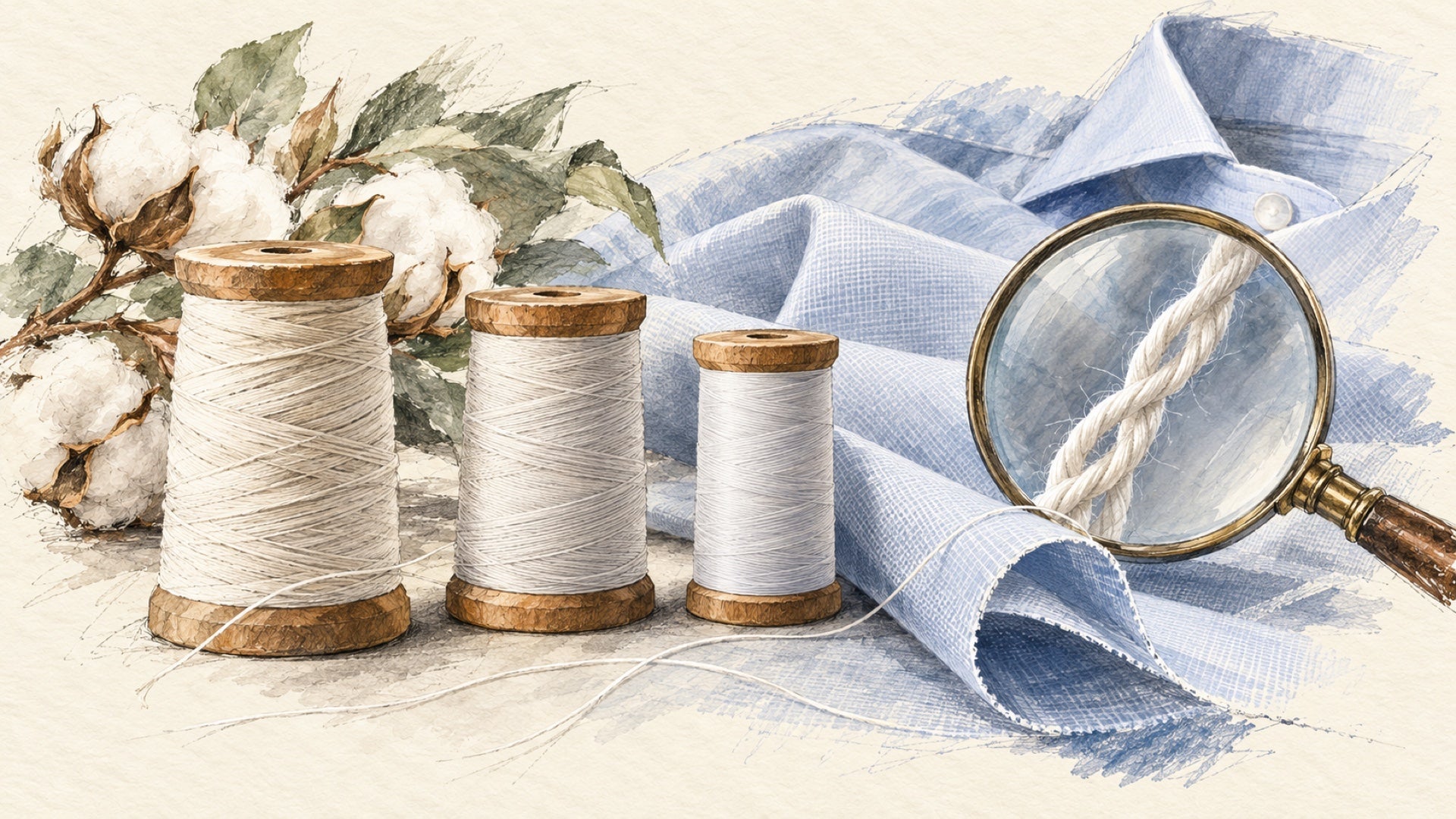
You may have read it on a label, in a product description, or heard it mentioned by a shirtmaker: "100/2 cotton," "120 two-ply," "a fine 140/2." These numbers sound technical, almost like laboratory specifications, and are often mentioned without explaining what they really mean. Yet the yarn count is a simple concept that says a lot about the shirt you wear and carries with it a piece of textile industry history. In this article, I will explain, without complicated formulas, what those numbers mean, where the system used to measure them comes from, and why the highest number is not always, automatically, the right choice.
What is yarn count?
Count is the measure of a yarn's fineness. Since directly measuring the diameter of a cotton yarn would be inconvenient and imprecise (yarn is soft, it flattens, and it is not perfectly cylindrical), the textile industry chose an indirect method: relating the yarn's length to its weight. For the same weight, a fine yarn is much longer than a coarse yarn. Therefore, the longer the yarn obtained from a certain weight of cotton, the finer the yarn.
There are several systems of yarn count. For shirt cotton, in the Italian and European tradition, the English count system is almost always used, indicated by the abbreviation Ne. This is the system to which the numbers 100, 120, 140, and so on refer.
The English system: a history born in the spinning mills of Lancashire
The English count system originated in industrial revolution-era England, when Lancashire and the Manchester area were the global heart of cotton spinning, so much so that Manchester was nicknamed "Cottonopolis." In that world, a common language was needed to buy and sell yarns, and the standard became the skein, or hank in English, measuring 840 yards, or about 768 meters.
The Ne count indicates how many of these hanks are needed to make one pound, about 454 grams. In practice:
- a Ne 50 yarn means that one pound of cotton produces 50 hanks of 840 yards;
- a Ne 100 yarn means that the same pound produces 100 hanks, so the yarn is twice as long and, consequently, finer;
- a Ne 140 yarn is even finer, because the same amount of cotton produces 140 hanks.
To give you a concrete idea: a Ne 100 yarn corresponds to about 77 kilometers of yarn for every pound of cotton. It is precisely this length that determines its fineness. There is only one rule to remember: the higher the number, the finer the yarn.
And the metric system?
There is also a metric count, indicated by Nm, which expresses how many kilometers of yarn are obtained from one kilogram of fiber. It is widely used for other fibers and in some sectors. The two scales are different and should not be confused: a Ne 100 corresponds approximately to an Nm 169. However, in shirtmaking, when you hear of 100/2 or 140/2, it almost always refers to the English count.
There are other systems as well, such as tex, which works in the opposite way: it indicates how many grams weigh one thousand meters of yarn, so in that case, a higher number means a coarser yarn. This is one of the reasons why, when talking about counts, it is always best to know which scale is being referred to. However, you can rest assured about your shirt: the standard remains that of the old English spinning mills.
What does "/2" mean: two-ply twisted yarn
Now for the second part of the number, the one after the slash. The "/2" indicates that the yarn is two-ply twisted: two single yarns, each of the indicated count, are twisted together to form a single yarn that is more even and stronger. A 100/2, therefore, is made of two Ne 100 yarns twisted together.
There is a detail here that confuses many: in terms of overall thickness, a 100/2 behaves approximately like a single Ne 50 yarn, because it combines two yarns. So why not just use a Ne 50? The answer lies in quality. Two-ply twisted yarn is:
- stronger, because the two yarns support each other and the small irregularities of one are compensated by the other;
- more even, with a more uniform appearance and a smoother surface;
- nicer to the touch, with a more compact hand and a more delicate luster.
In fabric descriptions, you may sometimes also find formulas such as "100/2 x 100/2": this means that both the warp, i.e., the longitudinal yarns, and the weft, i.e., the transverse ones, are made with the same two-ply twisted yarn. When one of the two is a single yarn, the number changes, for example "100/2 x 50/1". In shirtmaking, "double twisted" refers to when both directions of the fabric use two-ply yarns.
Why special cottons are needed for high counts
Not all cotton can become a 140/2. To spin such fine yarns, long fibers are needed, i.e., long-staple or extra-long-staple cottons, which can be twisted into a very fine yarn without breaking. This is why the highest counts are associated with fine and renowned varieties, such as certain Egyptian cottons, Sea Island cotton from the West Indies, or Pima cotton grown in the Americas. Short fibers can only produce coarser yarns, because the fibers are not long enough to "hook" together in a fine yarn.
This also explains why high counts cost more: the raw material is rarer, the spinning process is slower and more delicate, and weaving requires suitable looms and expertise.
Does a higher number always mean better?
This is the question everyone asks, and the honest answer is: it depends. A higher count gives a finer, softer, lighter, and silkier fabric. But it also brings with it some characteristics to be aware of:
- it is more delicate and, with heavy use, may wear out sooner than a fuller fabric;
- it tends to wrinkle more easily;
- it can sometimes be slightly more transparent, especially in light colors.
A 100/2 is already a very fine and versatile fabric; a 120/2 is even finer and smoother; a 140/2 or higher enters the realm of luxury fabrics, splendid but requiring a little more care. It is no coincidence that many shirtmakers consider the range between 100/2 and 120/2 the ideal balance between fineness and durability. And do not forget that count is only one of the elements: the quality of the fiber, the weave density, the finishing, and, of course, the construction also matter.
Be careful not to confuse them: the "Supers" of wool
One last curiosity: if you have heard of "Super 120's" or "Super 150's" wools in suits, know that this is another scale, related to the diameter of the wool fiber and not to the cotton yarn count. The numbers are similar, but the meaning is different.
A small code that says a lot
Now, when you read "100/2" or "140/2", you will know that behind those numbers are the English spinning mills of the 1800s, 840-yard hanks, two yarns twisted together, and long-staple cottons grown on the other side of the world. On our blog, you will find other curiosities about the world of shirtmaking. And if you want to feel with your own hands what changes between one fabric and another, discover the Affinito shirts: in our stores, it is always a pleasure to let you feel the difference.
Affinito Shirt Stores
You can try on the shirts, request custom sizing, and see the embroidery in person at all our retail locations:
- Afragola (NA): Via Alcide De Gasperi, 38
- Afragola (NA): Le Porte di Napoli Shopping Center, Via Santa Maria la Nova, 1
- Casalnuovo di Napoli (NA): Via Lagno, 7
- Frattamaggiore (NA): Piazza Riscatto, 28
- Nola (NA): Corso Tommaso Vitale, 112
- Nola (NA): Via San Felice, 65
- Quarto (NA): Via Masullo, 76
- Empoli (FI): Centro*Empoli, Via Raffaello Sanzio
- Bologna: Centronova Shopping Center
- Mondovì (CN): Mondovicino Shopping Center & Retail Park
- Posted in:
- Curiosità